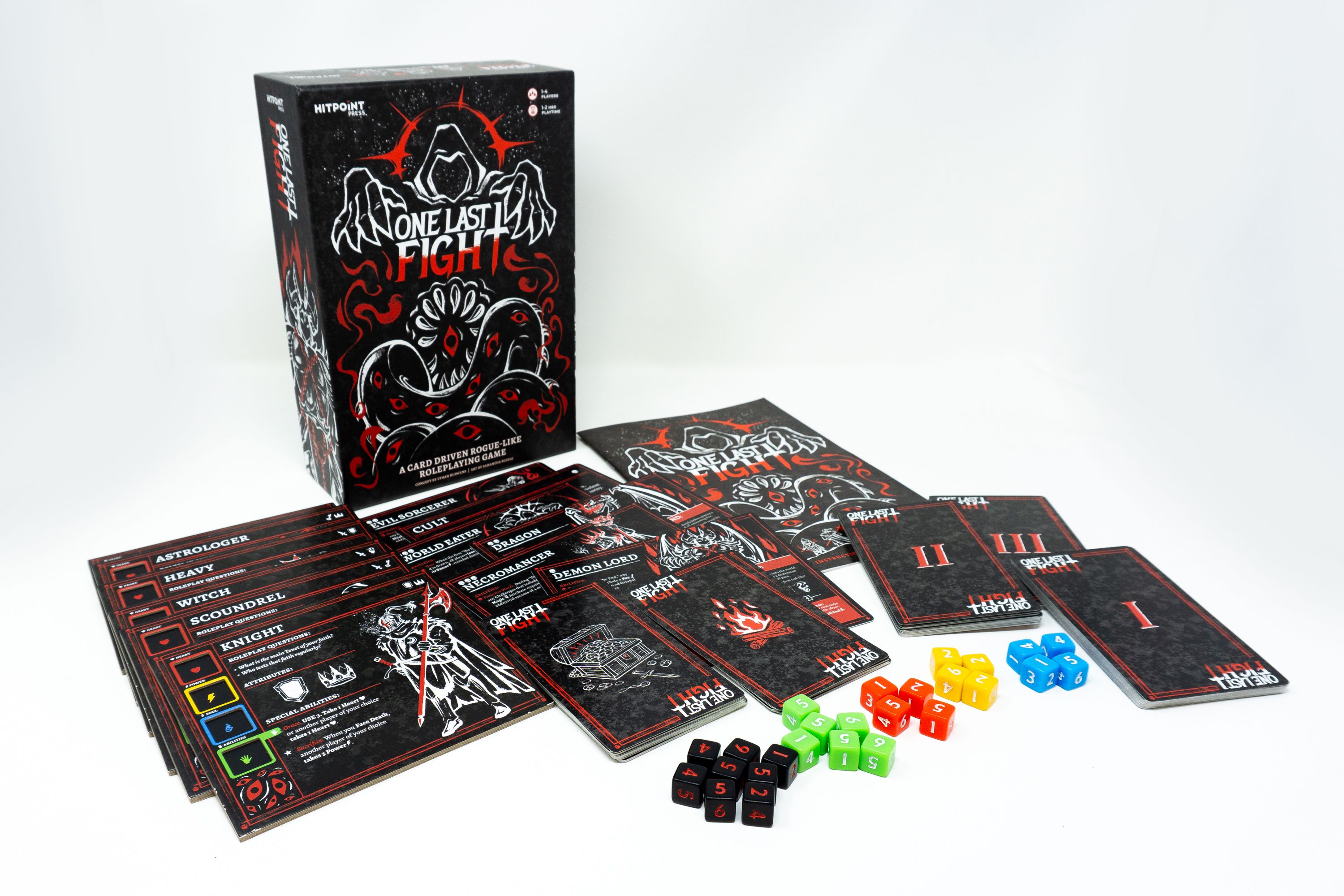
One Last Fight TTRPG drops players straight into a final boss battle
Summary
The terrific GM-less boxed one-shot TTRPG One Last Fight is built around the grand finale of a Dungeons & Dragons-style fantasy campaign.
It took years to unravel the conspiracy that was undermining our kingdom. Our valiant party of adventurers chased shadows and rumors all over the land. But as support for our kind and honorable king eroded and power-grasping lords rose up against him, we could see the country disintegrating around us, no matter how many petty plots we foiled, or how many agents of chaos we defeated.
Finally, we learned who was behind the lies, the schemes, the uprisings. It was the King’s own jester, the Harlequin, secretly a forgotten cousin who coveted the throne for himself, and resented the long-gone royals who begat and forgot his family line. By the time we uncovered his plot, he had his own subterranean army of powerful lieutenants and monstrous servants. It was up to us to save the kingdom, and the king we loved. We entered the Harlequin’s sanctum for one last fight.
That description might sound like the culmination of a years-long fantasy TTRPG campaign, but my friends and I generated it all in less than an hour when we sat down with Hit Point Press’ GM-less storytelling game One Last Fight. Its October 2024 Kickstarter campaign recently fulfilled for backers, and the game is now freshly available for retail purchase in Hit Point’s online store. One Last Fight is a no-prep one-shot game where one to four players head into their dramatic ultimate confrontation with their longstanding nemesis.
 Image: Hit Point Press
One Last Fight intrigued me from the minute I saw it, because I’m a huge fan of pick-up-and-play GM-less games and of TTRPG sessions that start dramatically in the middle of the action. It’s an easy-to-understand but mechanically rich game. Players start with simple character cards for archetypal fantasy heroes that feel familiar from Dungeons & Dragons (the Knight, the Scoundrel, the Illusionist, etc.), and answer questions that help build backstories and interparty connections. They pick a Nemesis to face and answer questions that create a longstanding enmity and stakes for the story. Then they take turns pulling cards from Act I, II, and III decks, which set up escalating challenges. The rewards for success expand the characters’ skills and earn them crucial items, making it more likely that they’ll survive future challenges. The setup lets the players design their own world and put their own spin on the game’s central concept of a final, decisive battle against evil.
Freelance game designer Ethan Hudgens (he/they) tells Polygon that he created the first iteration of One Last Fight in 2018 for an Itch.io game jam.
“It was called The End Jam,” Hudgens says. “It was about the endings of things, which is why the whole premise is that it's the last adventure, the ending of a campaign.”
From there, they continued to develop the game over the next few years, expanding it, adding more cards, and fine-tuning the mechanics. Eventually, Hudgens reached out to Hit Point Press about publishing the game, “because I knew that they made good cards.”
 Image: Hit Point Press
Hit Point Press content lead and game designer Jordan Richer tells Polygon that Hudgens’ query came at a key moment for the company. A leaked draft of a Wizards of the Coast memo suggested the company was going to significantly crack down on the existing “original gaming license” terms that allowed developers to make third-party content related to Dungeons & Dragons. Fans revolted. Wizards issued a series of apologies, explanations, and walkbacks. But the market for non-D&D RPGs soared, and in the wake of the OGL blowup, companies like Hit Point Press realized that being dependent on Wizards’ good will could be dangerous and limiting.
“Hit Point Press was looking pretty seriously at expanding into other things, because we do a lot of 5th Edition third-party stuff, so hearing from Ethan was great,” Richer says. “I knew they were an excellent game designer. We kept Ethan on helping expand some stuff [in the game] — writing stretch goals, fleshing out some stuff for the expansion. It’s been a collaborative process.”
Richer says the Hit Point staff’s primary addition to the game design ahead of the Kickstarter was in adding thematic sub-boss encounters to the nemesis cards. On the way to the villain, the players encounter significant resistance, with challenges ramping up sharply in difficulty. Some challenges are aimed at every player, while others are solo events. In each case, though, players use their skills to build a dice pool and try to accumulate successes to pass those challenges. Richer says in the original version of the game, the “nemesis encounters” were just a series of storytelling prompts, rather than mechanical challenges.
 Image: Hit Point Press
Still, Richer wanted the game design to encourage roleplay. It’s entirely possible to play One Last Fight as a purely mechanical game: “I enter this new location and I flip a card. It says the floor collapses under me, so I roll my Power attribute to not take damage. I got four successes, so I made it, and I get a new item. Your turn.” But it’s a richer experience if the players take the game’s questions, prompts, and events as roleplay opportunities, and play out how their characters deal with the inherent tension, anxieties, and potential catharsis of the battle they’ve been working toward for so long.
“Because it was our first non-D&D, kind of board game-ish crossover, we wanted to make sure there was a good amount of roleplaying in it,” Richer says. “The types of people Ethan and I would play games with when we were streaming, they’re going to cram a bunch of roleplaying into the game themselves, but we wanted to make sure that if someone was picking this up — say, from a pile of a thousand board games at a friend's birthday party — we'd want them to be able to understand how the storytelling part worked, and have lots of opportunities for it, but also have the opportunity to trim it all out if they didn't want to do it.”
My own experience with One Last Fight was terrific. (To be fair, I had an inventive, committed crew of really great players — a must for any GM-less storytelling RPG.) The scenario dropped us right at the culmination of a long, wearying conflict against the Harlequin, the nemesis we chose because it felt potentially stranger and less familiar than fighting some of the game’s more standard-issue fantasy villains, like the Dragon, Demon Lord, Cult, or Necromancer. (Though we did have to debate whether we wanted to face the Harlequin or the spooky-sounding Hungry House.)
 Image: Hit Point Press
Our battered, frustrated characters had given everything but our lives to this conflict, and now faced the likelihood that we were going to die taking our enemy down. Victory in One Last Fight is not guaranteed, and given some of my group’s hair’s-breadth successes on the way to our hard-won triumph over the Harlequin, it’s easy to see how a given one-shot might become the tragic story of a party dying in a heroic last stand.
But what’s promising about the game for me is its replayability. Using the same characters, villain, and story prompts, my group could have just as easily told a story about a party of cocky young upstarts who breezed through a bunch of simple conflicts that suddenly put us face to face with an irritated lich. Or a family that turned monster-hunting into a career and considers their upcoming face-off with a dragon the latest “final fight” of many. Or a thousand other variants. The “Illuminate” game expansion adds a lot more variety, with four new character archetypes and six new nemeses, plus cards to support them.
And Hudgens and Richer feel the game’s setup could lead to more expansions, in a variety of different themes.
“It's doing really well,” Richer says. “We're already working on a reprint, which is amazing, considering the game really just hit shelves. That’s a sign to us that it's time to work on something new. Whether it's this year or next year, I can't really speak to that, but Ethan and I have definitely thrown a lot of ideas around. I'm looking at whether we can turn it into a whole line? One Last Fight is kind of infinitely expandable, and then also mix-and-matchable.”
 Image: Hit Point Press
He hints that one idea on the table is a science fiction expansion that could “shuffle in with the original one, so you can have swords in space, and demons on spaceships, stuff like that. So it's definitely on our radar. The success is huge, so I think there's definitely room for expansions down the pipeline.”
“I have ideas, but I'm not allowed to say anything,” Hudgens laughs.
“Yeah, yeah, everything is secret right now,” Richer says.
There might be a bit of irony in a game called One Last Fight being so replayable, with the possibility of even more expansions drawing players back in for more “final” battles. But I’m fine with any given playthrough of this game not actually being the last one. One Last Fight is well-designed both on a physical and mechanical level, and the way it rapidly jumps players into the most meaningful part of an adventuring story made it a must-play for me. Fans of fantasy roleplaying (and maybe in the future, science fiction roleplaying?) should definitely give it a look.
The physical edition of One Last Fight’s core game is $39.99 at Hit Point Press’ site. The Illuminate expansion (strongly recommended) is $19.99. Both are available as a bundle for $59.99, or $99.99 for the bundled “Heavy Metal Edition,” which includes foil cards, a metal life counter and player token, and a themed dice tray, among other premium elements. A print-and-play digital version of the core game is $19.99.