Gothic Remake is committed to the original's immersive open world: 'You don't have a minimap, we very strictly kept that'
Summary
They considered "a card minigame, or maybe some fishing" but decided against stuffing it with filler.
The ghost of Gothic is everywhere. A direct ancestor of Kingdom Come: Deliverance and The Witcher, Gothic was the ultimate eurojank RPG, an ambitious if flawed reminder of a school of open world design that predates maps full of repeatable activities. Gothic's map didn't have icons on it. It was a believable in-world item you had to acquire by paying for it (or threatening the cartographer, if you were roleplaying as a big meanie).
In remaking Gothic, Alkimia Interactive kept that element of realism a priority. "You don't have a minimap," says game director Reinhard Pollice, "we very strictly kept that. We were thinking about making it optional, but we felt like even that doesn't feel right. If you want to know where you are, just open your map. You will find out."
And though they considered adding more activities, they decided not to overstuff that map. "We were debating about doing some minigames to fill it up more," Pollice says. "Having a card minigame, or maybe some fishing minigame. Who knows what the future holds for Gothic, maybe we'll do them one day. But we didn't see them as a priority thing. We felt like they're not really needed for the core experience."
Article continues below
The core experience of Gothic was an authentic and gritty medieval RPG. When we talk about eurojank we often focus on the jank, but the euro is important too. Gothic was developed in Germany and massively popular in Poland, it's the kind of fantasy made by people who live in places haunted by their history, as opposed to fantasy made by people whose ideas of the Middle Ages come from a theme restaurant.
Generalizing wildly, high-fructose American fantasy is much more likely to be about chosen ones, nobility, rulership—even the grim low-fantasy Game of Thrones is explicitly about who gets to run Westeros. European fantasy often shifts the focus to commoners, and Gothic is common as muck.
(Image credit: THQ Nordic)
"It had this down-to-earth, grounded type of writing," Pollice says. "At least, the original German version. When we set out, we also realized that maybe one of the reasons why it wasn't so popular in English-speaking territories was that the writing was a little bit hit and miss in the English version. That was one of the things we started very early on, that we did a rewrite of the original English version, and we decided to get this distinct working-class feeling and tone into it."
Gothic's setting is a penal colony where prisoners were sent to work in the mines. Now they've rebelled and become independent, but three factions have emerged that all have their own ideas about what they're struggling for and how to achieve it. As a fresh fish in this murky pond, you have to choose who to side with and work for. Early on, you can take jobs for all three at once, ending up with quite a lot on the old to-do list, and that's one area where Alkimia Interactive decided actually a little more hand-holding would be good.
Keep up to date with the most important stories and the best deals, as picked by the PC Gamer team.
"We felt that maybe the way Gothic handled guidance back then just wasn't enough," Pollice says. "I mean, it had a very bare-bone quest log, so we extended that. You now have the option instead—you have a diary-style quest log, but you also have an objective view where you can see, OK, what does it boil down to? What do I have to do? But it's always written in this immersive context of being what would the hero know."
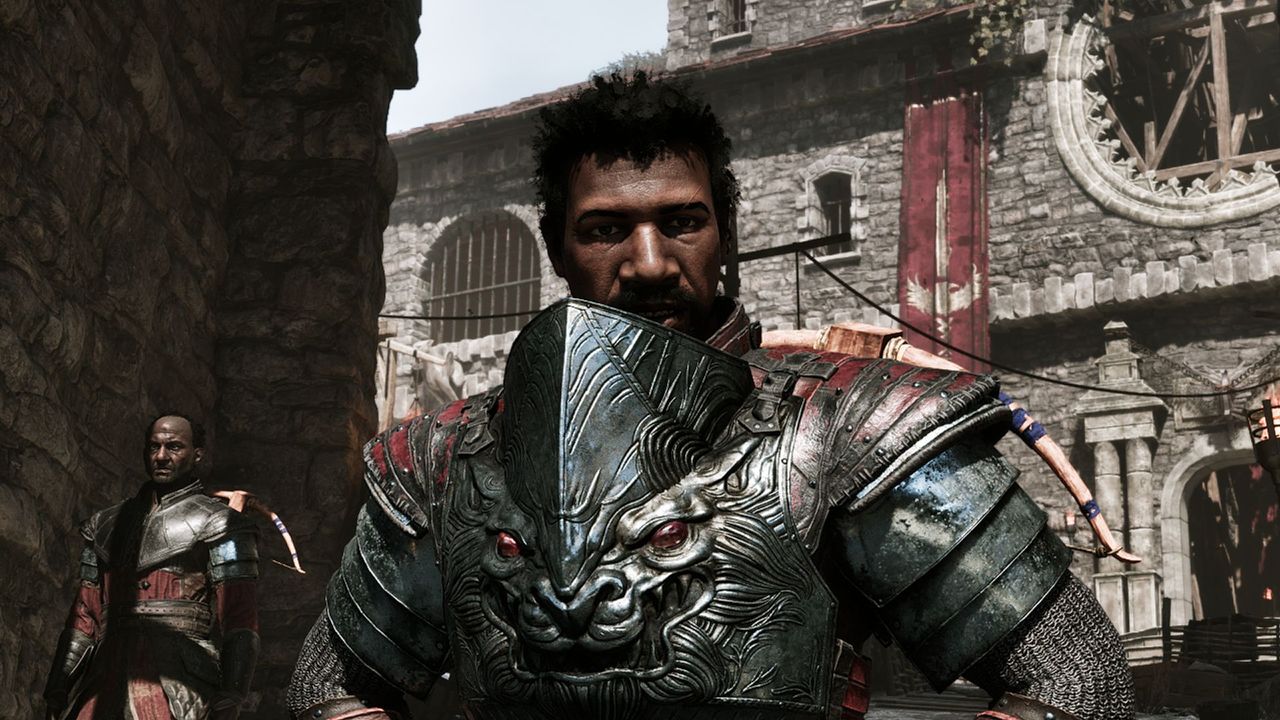
That hero remains the canonical Nameless Hero from the original Gothic games, complete with stubble and a ponytail that makes him look like a roadie for Iron Maiden. While character customization was considered in the first stages of development, ultimately it was abandoned. "We had everything on the table," Pollice says, "but we quickly discarded that as being a very important thing. We felt like the Nameless Hero is known for a specific type of look, and it's a hero's journey in a way. We didn't really lean into character customization. You can customize the armor set you're using."
(Image credit: THQ Nordic)
Another bit of authenticity the original Gothic's known for is its forge where you could heat up raw steel, hammer it on the anvil, cool it in water, sharpen it with a whetstone, and end up with your own handmade sword. It didn't have Henry of Skalitz whistling while he worked, but it was a memorable addition.
"The crafting's one of the things we also extended greatly," Pollice says. "In the original it had a quite elaborate crafting system with regards to the forge, crafting weapons, but we even expanded that further. Now you have an alchemy system, you have a spell, a scroll-inscription system. The cooking is more elaborate, and you have to also find recipes."
(Image credit: THQ Nordic)
The other elaborate system Gothic pioneered was NPC behaviors and routines. They would read books, play music, cook and eat, and train with swords. Gothic and Vampire: The Masquerade – Bloodlines remain the only RPGs I've played where NPCs will even go piss on a wall, and Pollice reassures me that's not going to change. "It's still in the game," he says. "Yeah, they definitely piss on the wall."
Gothic Remake will be available on June 5 via Steam and GOG.